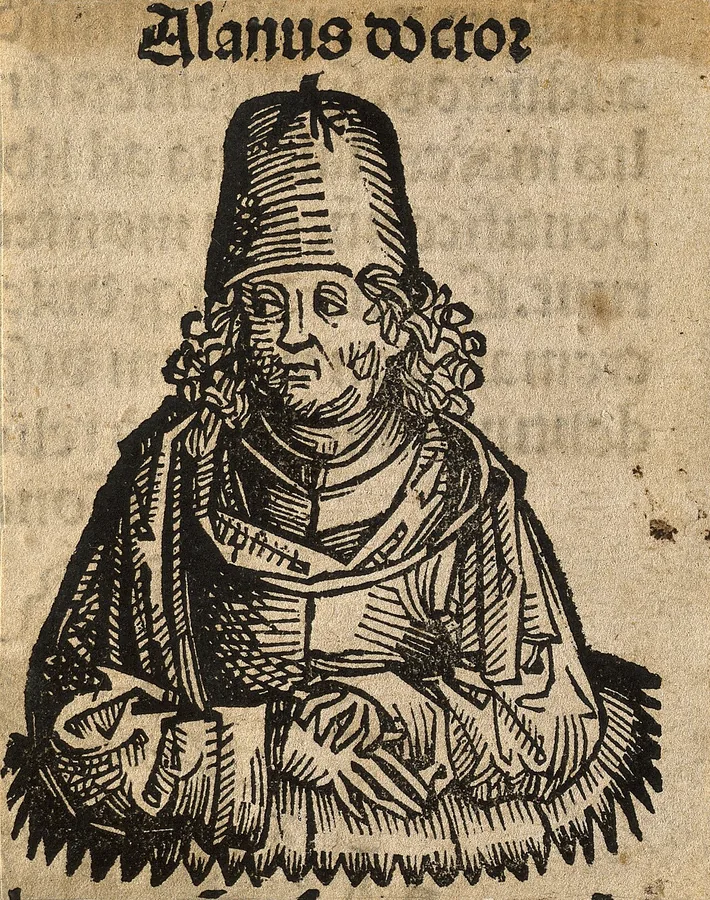
Author
Alan of Lille
1120–1202
Alan of Lille (c. 1120–1202), known in Latin as Alanus de Insulis, was probably born at Lille in Flanders. He taught the liberal arts and theology at Paris and later in the south of France, where he preached against the Cathars, and he died at Cîteaux, where he had entered the Cistercian order late in life. His learning earned him the name Universal Doctor.
He was both a theologian and one of the major Latin poets of the twelfth century. His Theologicae regulae attempt to set out theology as a series of axioms in the manner of a geometry, and De fide catholica argues against Cathars, Waldensians, Jews and Muslims. His allegorical poems De planctu naturae and Anticlaudianus, about Nature and the making of a perfect man, were read and imitated throughout the Middle Ages, and his manual on preaching was one of the first of its kind.
The library holds a wide selection of his works, among them the Theologicae regulae, De fide catholica, De arte praedicatoria, De planctu naturae and several of his rhythmical poems. The Theologicae regulae are the best introduction to his theological method.
Works
Texts currently available in the library.
De angelica hierarchia
A short treatise by Alan on the order of angels.
De arte praedicatoria
Alan's manual for preaching, in which the best concepts are offered for composing sermons on almost every moral topic, with specific guidance on how to preach to various groups.
De fide catholica
Alan of Lille's De fide catholica contra haereticos sui temporis is a four-book late-twelfth-century exercise in Christian polemic. Written in the scholastic world of Paris and southern France, it organizes arguments against the religious positions Alan associated with Cathars, Waldensians, Jews, and Muslims, using Scripture, patristic authorities, and dialectical reasoning to articulate Catholic doctrine. The work is valuable both as a theological synthesis and as evidence for how learned Latin writers classified and contested religious difference; modern historians caution that its descriptions are polemical constructions, not transparent reports of communities. Schola presents the Latin text and an English translation.
In progress
De planctu naturae
Alan of Lille's De planctu naturae ("The Complaint of Nature") is a twelfth-century Latin prosimetrum in which personified Nature laments human disorder and the misuse of sexuality and language. Probably composed around the 1160s–1170s, it joins Boethian consolation, Chartrian cosmology, Christian moral critique, and elaborate rhetoric. Its allegory helped shape later medieval representations of Natura, especially Jean de Meun's continuation of the Roman de la Rose and the tradition that reaches Chaucer. Schola presents the Latin text with an English translation.
Expositio super orationem Dominicam
A commentary on the Lord's Prayer by Alan. Latin transcribed from Analecta cisterciensia vol. 31.
Expositio super symbolum Apostolorum
A commentary on the Apostles' Creed by Alan.
Expositio super symbolum Nicenum
A commentary on the Nicene Creed by Alan.
Liber parabolarum
Book of parables or proverbs by Alan. Contains moral and religious analogies written in verse. Translated with Sonnet 5. Latin transcribed from PL210, Migne.
Quod non est celebrandum bis in die
A letter by Alan of Lille explaining why a priest should not celebrate Mass twice in a day except in necessity. Latin transcribed from Marie-Thérèse d’Alverny, Alain de Lille: Textes inédits (1965), pp. 290–294; English translation drafted with Sonnet 5 and submitted by the contributor.
Rhythmus de amore Veneris
A poem against the love of Venus, that is, lust, that warns of the ruin that comes from adultery.
Rhythmus de incarnatione Christi
A poem about how the seven liberal arts are related to the incarnation of Christ.
Rhythmus de miseria mundi
A poem in which the fleeting and perishable nature of man is graphically depicted.
Theologicae regulae
Alan's theological rules, wherein he sets forth over a hundred concise maxims.