Bonaventure and Thomas Aquinas became masters of theology at Paris in the same year, 1257. That year Bonaventure was elected minister general of the Franciscans, and he governed the order for seventeen years. His theology is Augustine's: all things come from God, bear his image, and lead the mind back to him. The Itinerarium mentis in Deum traces that road in a few pages; the Breviloquium sets out the whole of doctrine on it.
His students made the first Franciscan school. John Pecham disputed with Thomas at Paris and, as Archbishop of Canterbury, renewed the Oxford condemnation of Thomas's single substantial form; Matthew of Aquasparta defended Augustine's divine illumination. Within a generation Scotus had taken their place in the Franciscan schools.
Sixtus V, himself a Franciscan, made him a Doctor of the Church in 1588 and had his works printed at the Vatican. While most Franciscan schools taught Scotus, the Capuchins made Bonaventure their master. Trigoso gathered a Summa from his writings; Bonaventure of Langres printed his positions and Thomas's side by side on the same page; Gaudenzio of Brescia died preaching in Lent 1672, and his students assembled his course in seven volumes; Barbieri taught young friars from his own courses ad mentem S. Bonaventurae for fifty years.
The Quaracchi edition (1882–1902) gave scholars a reliable text. Since then Bonaventure has had readers rather than a school: Gilson, whose study of 1924 made him a philosopher to argue with again, and Ratzinger, whose Habilitation read him on the theology of history.
The line of the school
3 authors, 6 works in the library →Bonaventure and his students
The first Franciscan school, at Paris and Oxford, until Scotus.
- c. 1217–1274
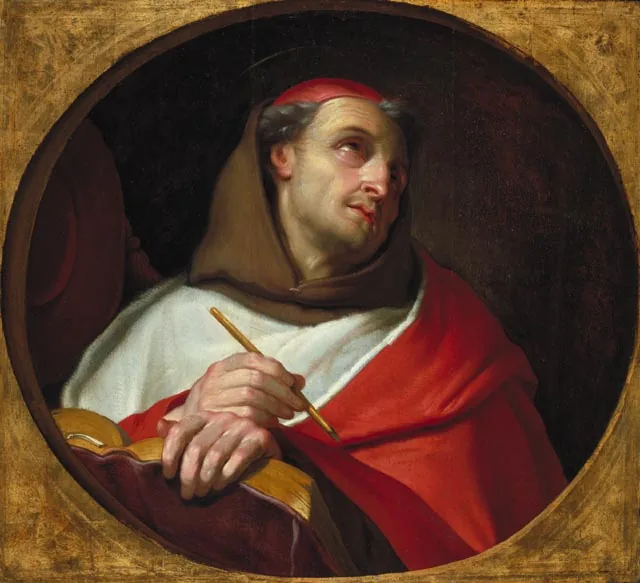 BonaventureThe Seraphic Doctor: the Commentary on the Sentences, the Breviloquium, the Itinerarium.Franciscan · Latin, English, Spanish
- c. 1230–1292John PechamDisputed with Thomas at Paris; as Archbishop of Canterbury from 1279, renewed the Oxford condemnation of Thomas's single substantial form.Franciscan · not yet in the library
- c. 1238–1302Matthew of AquaspartaBonaventure's closest heir: questions on knowledge that defend divine illumination; minister general, then cardinal.Franciscan · not yet in the library
The Capuchin school
From Trigoso to Barbieri the Capuchins taught Bonaventure as a complete course, while the other Franciscans taught Scotus.
- 1533–1593Peter Trigoso of CalatayudA Summa theologica compiled from Bonaventure's writings, Rome 1593.Capuchin · not yet in the library
- 1609–1682Marcel of RiezThe Summa seraphica (Marseille, 1669): Bonaventure's theology, scattered through his commentary on the Sentences, gathered into the order of the schools.Capuchin · not yet in the library
- fl. 1655Bonaventure of LangresHis Bonaventura et Thomas (Lyon, 1655) sets the two doctors' positions on facing columns of the same page.Capuchin · not yet in the library
- 1612–1672
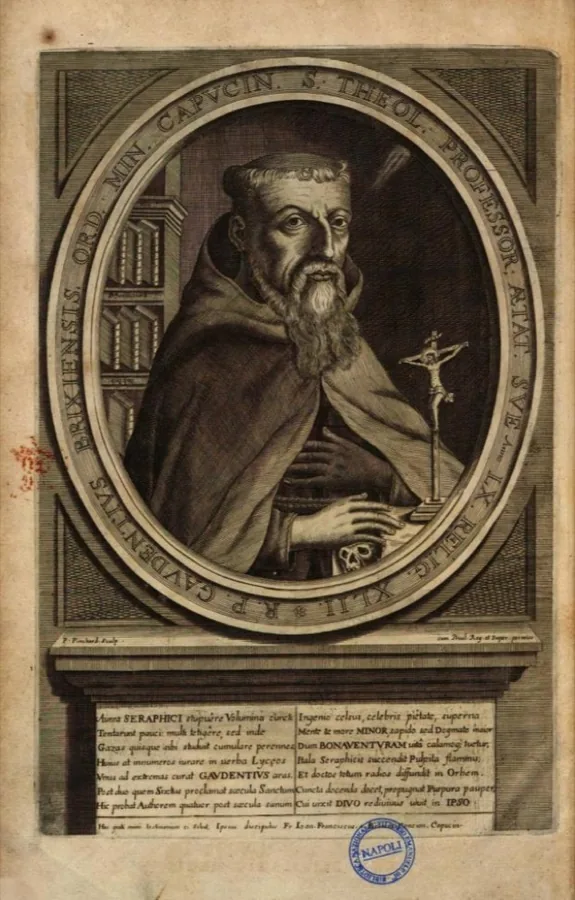 Gaudenzio of BresciaDied on a Lenten preaching mission before finishing; his students made the Palladium theologicum (Lyon, 1676) from his papers, often setting Bonaventure's answers beside Thomas's.Franciscan · Latin, English
- 1615–1697
 Bartolomeo BarbieriTaught young Capuchins for some fifty years, from courses of philosophy (1677) and theology (1687) ad mentem S. Bonaventurae.Franciscan · no works here yet
Editors and readers
The Quaracchi friars gave him a critical text; after them he has had students rather than a school.
- 1823–1904Ignatius JeilerDirected the Quaracchi edition of the Opera omnia, 1882–1902.Franciscan · not yet in the library
- 1927–2022Joseph RatzingerHis Habilitation on Bonaventure's theology of history, before he was Pope Benedict XVI.not yet in the library
- todayThe next reader of BonaventureThe line continues with whoever reads, translates or corrects these texts now.Read, translate or correct a text of the school →
Further reading
- “Saint Bonaventure”, Stanford Encyclopedia of PhilosophyCreation, illumination and the exemplars, with a guide to his works.
- Jay M. Hammond, J. A. Wayne Hellmann and Jared Goff, eds., A Companion to BonaventureHis life, his texts and his theology, chapter by chapter.
- Rafael Ramis Barceló, La segunda escolásticaWhere the Capuchins' Bonaventurian school stood among the others. In Spanish; free to read.