Author
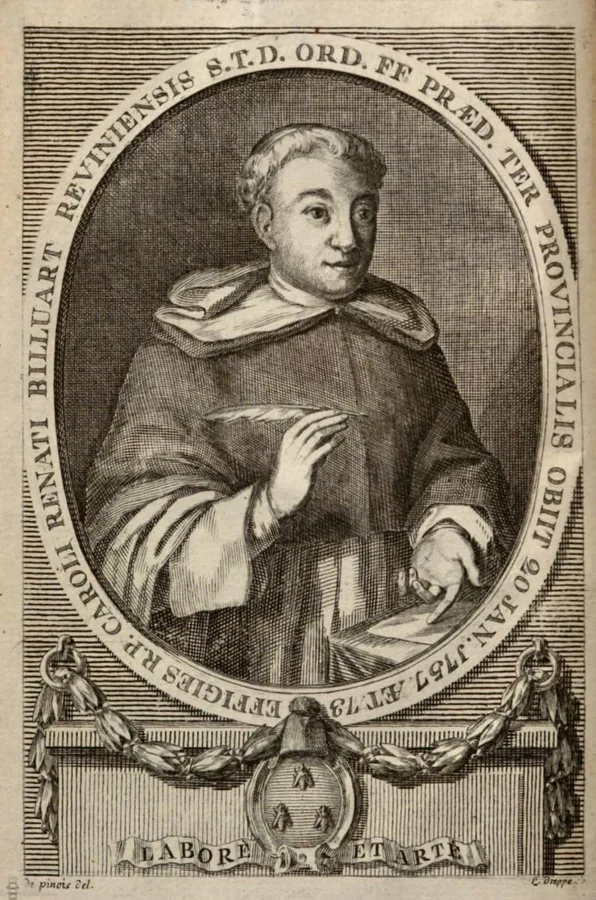
Charles René Billuart
1685–1757
Charles René Billuart (1685–1757) was born at Revin in the Ardennes and entered the Dominican order in 1701. He taught philosophy and theology in the houses of his province, including Douai, served several times as prior of the convent at Revin and was provincial of the Gallo-Belgian province of his order. He was also active in the controversies over Jansenism.
His fame rests on the Summa Sancti Thomae hodiernis academiarum moribus accommodata, written at the request of his province and published in nineteen volumes between 1746 and 1751. It follows the order of Thomas's Summa but presents its teaching in the form of dissertations suited to the university teaching of his day, defending classical Thomist positions, notably on grace and physical premotion, against Molinist and Jansenist opponents. He also produced a shorter compendium of it, the Summa Summae.
The library holds the Summa Summae S. Thomae in three volumes. Its brief, structured treatment of each question makes it a convenient guide to the Thomist positions argued at length elsewhere in the library.
Works
Texts currently available in the library.
Summa summae S. Thomae sive compendium theologiae
1754Charles René Billuart, O.P.'s Summa summae S. Thomae sive compendium theologiae (Liège, 1754) is his six-volume abridgment of the larger Summa S. Thomae hodiernis academiarum moribus accommodata (1746–1751). It condenses Aquinas's order and teaching into a reference manual while retaining the Dominican's characteristic distinctions, scholastic proofs, and historical material. The compendium belongs to the eighteenth-century consolidation of post-Tridentine Thomist education and helped carry Billuart's influential reading of Aquinas into later schools. Schola presents the Latin text with an English translation from its public-domain source.
Summa summae S. Thomae, Tomus II
1884Charles-René Billuart, O.P.'s Summa summae S. Thomae sive compendium theologiae, Tomus II, treats human acts, passions and virtues, sin, law, and grace in the Thomistic manual tradition. Schola presents the complete Latin Tome II from the Paris Vives edition of 1884.