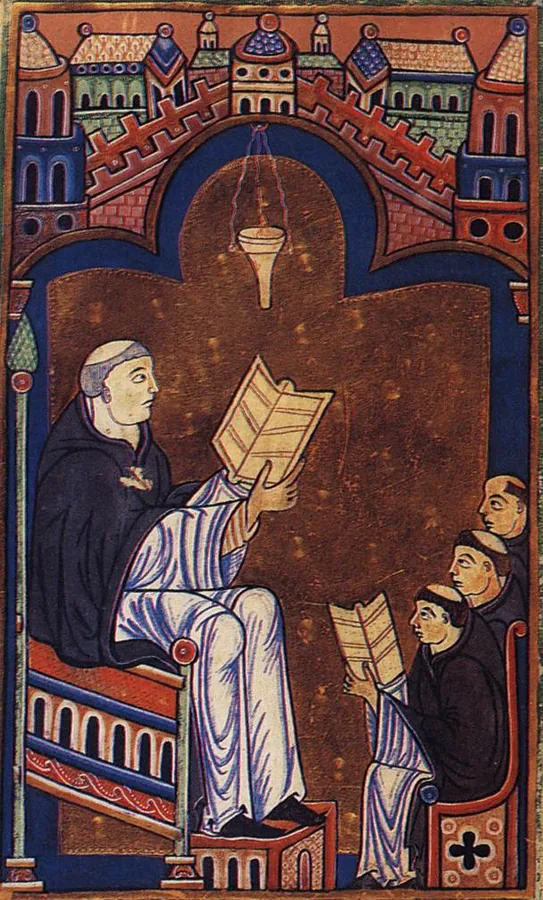
Author
Hugh of Saint-Victor
1096–1141
Hugh of Saint-Victor (1096?–1141) was probably born in Saxony and educated by the Augustinian canons of Hamersleben. Around 1115 he came to the abbey of Saint-Victor in Paris, a house of canons regular founded by William of Champeaux, where he spent the rest of his life teaching. From 1133 he directed its school. Some sources place his origin in Flanders or Lorraine instead.
Hugh gave the twelfth-century schools one of their first comprehensive accounts of theology. His Didascalicon sets out an ordered programme of study, from the liberal arts to Scripture, and his De sacramentis christianae fidei presents the whole of Christian doctrine as the history of creation and restoration. His teaching that every branch of learning serves the reading of Scripture, and his integration of contemplation with study, shaped the Victorine school and influenced Peter Lombard, Bonaventure and the later scholastics.
The library holds De sacramentis legis naturalis et scriptae, a short dialogue on the sacraments before Christ; Institutiones in Decalogum, on the Ten Commandments; and his commentary on the Celestial Hierarchy of Dionysius. The commentary shows how the twelfth century read Dionysius before the great scholastic commentaries.
Works
Texts currently available in the library.
Commentariorum in Hierarchiam Coelestem S. Dionysii Areopagitae
1854Hugh of Saint Victor's commentary on Dionysius's *Celestial Hierarchy*, prepared from *Patrologia Latina* 175. The reader contains Hugh's exposition only; Dionysius's quoted Littera is supplied by the linked canonical work.