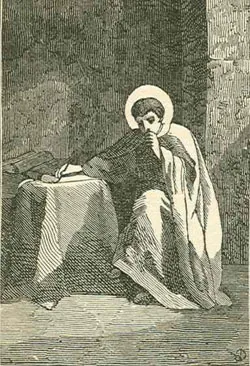
Author
Prosper of Aquitaine
390–463
Prosper (c. 390–c. 463) was a lay theologian, probably from Aquitaine, who lived at Marseille in the 420s. With his friend Hilary he wrote to Augustine about monks in southern Gaul who rejected Augustine's teaching on grace, and after Augustine's death he travelled to Rome to seek Pope Celestine's support. He later worked in Rome, probably in the service of Pope Leo the Great, and continued the chronicle of Jerome to 455.
Prosper was Augustine's principal defender in the controversy later called semi-Pelagian. In his early polemics he restated Augustine's teaching closely; in his later work he gave more weight to the will of God that all be saved, while keeping the priority of grace. Through him Augustine's doctrine passed into the Gallic and Roman tradition, and the Council of Orange in 529 drew on his compilations.
The library holds Liber contra Collatorem, his reply to Cassian's thirteenth Conference, and De vocatione omnium gentium, on God's call to all nations, which is usually attributed to him. Reading the two together shows how his position developed.
Works
Texts currently available in the library.
De Vocatione Omnium Gentium
1846*De Vocatione Omnium Gentium* is a theological treatise devoted to the difficult relationship between divine grace, human freedom, election, and God’s will that all men should be saved. Beginning from the controversy over whether the primacy of grace abolishes free will, the work argues that grace does not destroy human volition but heals, directs, and perfects it, while every genuinely salvific good ultimately originates in God. Through sustained engagement with Scripture, it examines the meaning of universal biblical expressions concerning salvation, the distinction between general and special gifts of grace, the mysterious diversity of God’s dealings with peoples and individuals, and the gradual calling of the nations into the Church. Particular attention is given to the history of salvation, from the earliest ages and Israel’s election to the worldwide preaching of the Gospel, while repeatedly insisting that the hidden reasons for divine election and the differing times of vocation remain beyond human scrutiny. The result is a careful attempt to uphold simultaneously the universality of God’s saving goodness, the necessity and gratuity of grace, human responsibility, and reverence before the inscrutable judgments of divine providence.
Liber contra Collatorem
1846Liber contra Collatorem is a theological treatise by St. Prosper of Aquitaine written in defense of St. Augustine’s doctrine of grace against the views associated with John Cassian’s thirteenth Conference. Prosper examines a series of propositions concerning grace, free will, the origin of good intentions, merit, perseverance, and human cooperation with divine assistance, arguing that Cassian’s position departs from Catholic teaching whenever it attributes the beginnings of saving willing or action to unaided human nature. Throughout the work, he appeals extensively to Scripture, ecclesiastical authority, conciliar decisions, and earlier anti-Pelagian controversies, presenting Augustine’s theology as continuous with the doctrinal judgments of the Church. The treatise culminates in a systematic recapitulation of Cassian’s principal definitions and a broader defense of the primacy of divine grace in every stage of the Christian life, while affirming that grace does not abolish human freedom but restores, directs, and strengthens it.