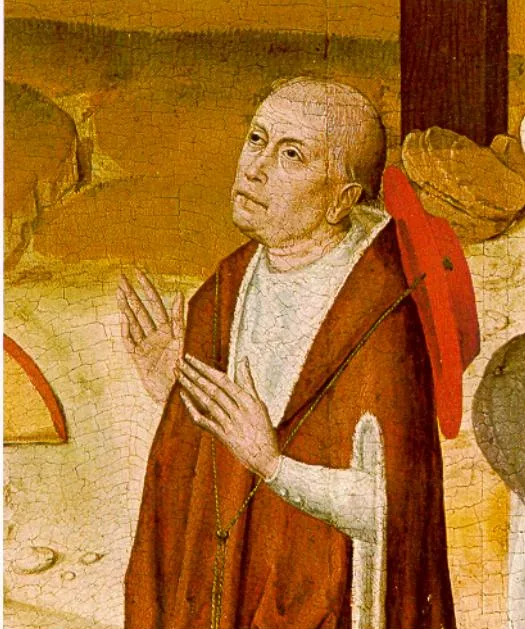
Author
Nicholas of Cusa
1401–1464
Nicholas of Cusa (1401–1464) was born at Kues on the Moselle and studied at Heidelberg, Padua and Cologne. He took part in the Council of Basel, at first supporting the council against the pope and later moving to the papal side, and travelled to Constantinople in 1437 in the cause of union with the Greek Church. He was made a cardinal in 1448 and bishop of Brixen in 1450, and he spent his last years in Rome.
His De docta ignorantia of 1440 argues that God, the absolute maximum, is beyond every proportion and comparison, so that the highest knowledge of him is a learned ignorance, in which opposites coincide. He developed this theme in mathematical, cosmological and mystical writings that drew on Dionysius and the Platonic tradition, and he wrote on church reform and on peace among religions.
The library holds De docta ignorantia and De visione Dei. De visione Dei, written for the monks of Tegernsee, uses a portrait whose eyes seem to follow every viewer as an image of God's sight, and is the more accessible starting point.
Works
Texts currently available in the library.
De docta ignorantia
De docta ignorantia (On Learned Ignorance, 1440), in three books: the absolute maximum (God), the contracted maximum (universe), and Jesus Christ. Latin text transcribed from the Rotta 1913 Bari edition.
De visione Dei
De visione Dei, or De icona (On the Vision of God, 1453), addressed to the Benedictines of Tegernsee: seeing God through the icon that gazes on all. Latin transcribed from the 1514 Paris Opera; English translation new.