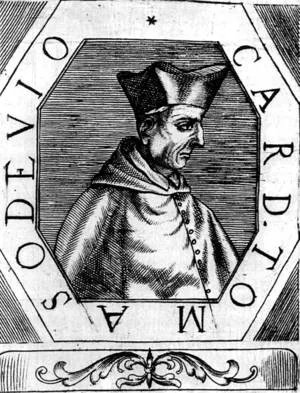
Author
Tommaso de Vio Cajetan
1469–1534
Tommaso de Vio (1469–1534) took the name Cajetan from his birthplace, Gaeta, between Rome and Naples. He entered the Dominican order at fifteen and taught metaphysics and theology at Padua, Pavia and Rome. He was Master General of the order from 1508 to 1518, became a cardinal in 1517, and as papal legate in Germany examined Martin Luther at Augsburg in 1518. He was later bishop of Gaeta.
Cajetan wrote the first complete commentary on the Summa theologiae, completed in 1520, which Leo XIII ordered printed beside the text in the Leonine edition. His interpretation of Thomas on analogy, on the distinction of essence and existence and on the natural desire to see God set the terms for later Thomism, and his readings were debated by Silvestri, Báñez and John of St. Thomas. In his last years he wrote literal commentaries on most of the Bible.
The library holds his commentary on the Prima Pars of the Summa theologiae; his commentary on Thomas's De ente et essentia, an early work on the foundations of his metaphysics; and De divina institutione pontificatus, his 1521 defence of the divine institution of the papacy.
Works
Texts currently available in the library.
Commentaria in Primam Partem Summae Theologiae
1507Cardinal Tommaso de Vio Cajetan's Commentaria in primam partem Summae theologiae is a sustained, article-by-article exposition of Aquinas's Prima Pars. Cajetan composed the commentary between 1507 and 1522 amid the Renaissance recovery and systematization of Thomism; it was subsequently printed alongside the Summa in the Leonine edition and became a standard lens through which later theologians read Aquinas. Its analyses of analogy, divine knowledge, creation, and the structure of sacred doctrine exemplify the technical method of early modern Thomist commentary. Schola presents the Latin text in the Leonine commentary tradition.
In progress
On the Divine Institution of The Papacy
1521In this treatise, Cardinal Cajetan examines the foundations of the Catholic Church and the authority of the papacy, arguing against conciliarism and addressing the question of a heretical pope.
In De ente et essentia D. Thomae Aquinatis commentaria
1907Cajetan's complete commentary on De ente et essentia, using the public-domain Michael de Maria 1907 edition as the production fallback witness, with an aligned English translation.