Author
Giles of Rome
1243–1316
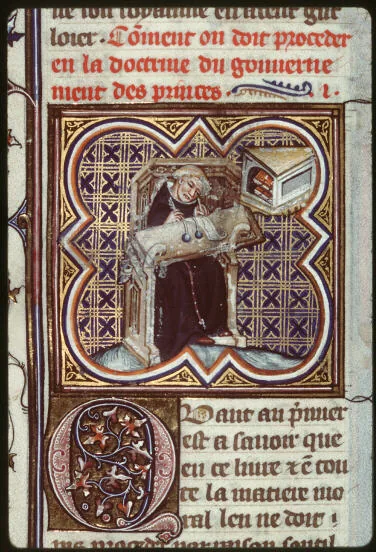
Giles of Rome (c. 1243–1316) entered the Order of Hermits of Saint Augustine at Rome as a young man and studied at Paris, probably hearing Thomas Aquinas during his second Parisian regency. His defence of positions linked to Thomas brought him into conflict with the condemnations of 1277, and he was kept from the degree of master until 1285. He then became the first master of theology of his order, its prior general in 1292 and Archbishop of Bourges in 1295.
Giles developed a metaphysics of the real distinction between essence and existence, sharpening a thesis of Thomas's into a dispute that lasted for generations. In 1287 his order adopted his teaching as its official doctrine, and he is regarded as the founder of the Augustinian school. His De regimine principum, written for the future Philip IV of France, was widely read as a manual of government, while his De ecclesiastica potestate, written during the conflict between Philip IV and Boniface VIII, argued for the supremacy of papal power and stands behind the bull Unam sanctam.
The library holds De ecclesiastica potestate and the Theoremata de esse et essentia, his principal statement on essence and existence.
Works
Texts currently available in the library.
De Ecclesiastica Potestate
1929Giles of Rome’s major treatise on ecclesiastical authority, written around 1302 amid the conflict between Boniface VIII and Philip IV of France. It presents a systematic account of papal plenitude of power, placing temporal jurisdiction and legitimate dominion within an order ultimately dependent upon the supreme authority of the Church.
Theoremata de Esse et Essentia
1930Giles of Rome’s Theoremata de esse et essentia offers a compact yet systematic presentation of some of the central principles of his metaphysics. Organized into twenty-two theorems, the work examines esse as a participated perfection, the metaphysical constitution of created beings, and the real distinction between essence and existence. It also considers the relation of esse to form, causality, and the dependence of creatures upon the first principle. The text follows Edgar Hocedez’s critical edition (Louvain, 1930).