Author
Thomas Aquinas
1225–1274
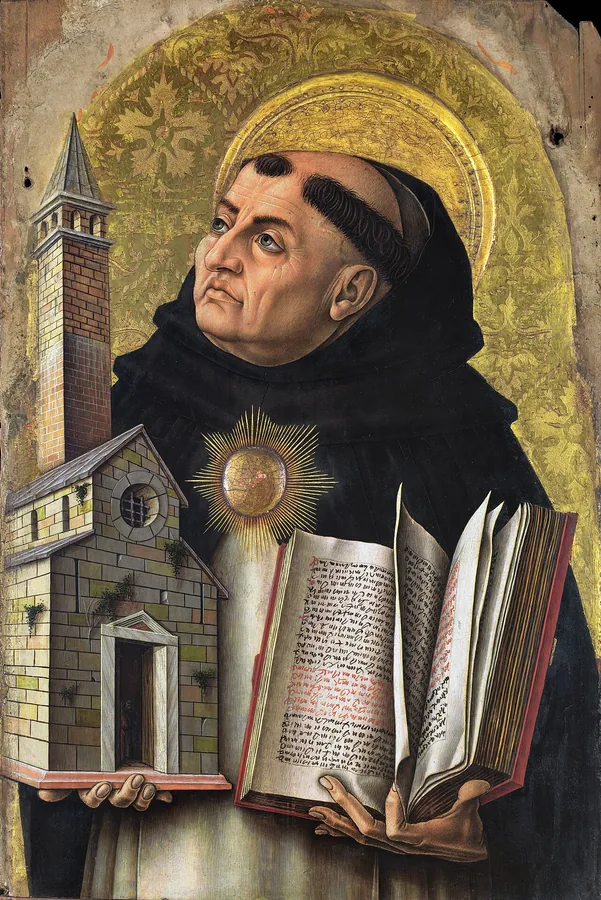
Thomas Aquinas (1225–1274) was born at Roccasecca, between Rome and Naples, and educated at Monte Cassino and Naples, where he joined the Dominicans against his family's wishes. He studied under Albert the Great at Paris and Cologne, and taught at Paris, Orvieto, Rome and Naples. He died on the way to the Second Council of Lyon. He was canonized in 1323 and declared a Doctor of the Church in 1567.
Thomas built a theology that uses Aristotle's philosophy as its instrument while drawing above all on Scripture, Augustine and the Fathers. His teaching on being and essence, on the relation of nature and grace, and on the virtues became the reference point of the scholastic tradition. From the sixteenth century the Summa theologiae replaced Peter Lombard's Sentences as the textbook of the schools, and the Thomist commentators gathered in this library (Cajetan, Silvestri, Báñez, John of St. Thomas, Billuart) wrote in its order.
The library holds the Prima Pars of the Summa theologiae, the four books of the Summa contra Gentiles and three short treatises: De ente et essentia, De principiis naturae and De aeternitate mundi. De ente et essentia is the shortest way into his metaphysics; the Prima Pars is the text most of the commentaries here explain.
Works
Texts currently available in the library.
Summa Theologiae, Prima Pars
1268Thomas Aquinas's Summa theologiae, Prima Pars, is the first major movement of his mature theological synthesis, composed chiefly in the 1260s and completed at the end of the decade. It begins with sacred doctrine and treats God's existence, attributes, Trinity, creation, angels, providence, and human nature in a deliberately ordered sequence of questions and articles. The work's combination of revealed theology, Aristotelian philosophy, and disputational method made it one of the most influential texts in Western theology and philosophy, generating centuries of commentaries, including Cajetan's. Schola presents the Latin Leonine text.
In progress
Summa contra Gentiles, Liber I
1918The Summa contra Gentiles (1259-1265) is St Thomas Aquinas's great apologetic and missionary work. Liber I of this edition reproduces the critical text of the Leonine Opera omnia, tomus XIII (Rome, 1918), with the commentary of Franciscus de Sylvestris Ferrariensis printed with the text.
Summa contra Gentiles, Liber II
1918The Summa contra Gentiles (1259-1265) is St Thomas Aquinas's great apologetic and missionary work. Liber II of this edition reproduces the critical text of the Leonine Opera omnia, tomus XIII (Rome, 1918), with the commentary of Franciscus de Sylvestris Ferrariensis printed with the text.
Summa contra Gentiles, Liber IV
1918The Summa contra Gentiles (1259-1265) is St Thomas Aquinas's great apologetic and missionary work. Liber IV of this edition reproduces the critical text of the Leonine Opera omnia, tomus XV (Rome, 1930), with the commentary of Franciscus de Sylvestris Ferrariensis printed with the text.
Summa contra Gentiles, Liber III
1926The Summa contra Gentiles (1259-1265) is St Thomas Aquinas's great apologetic and missionary work. Liber III of this edition reproduces the critical text of the Leonine Opera omnia, tomus XIV (Rome, 1926), with the commentary of Franciscus de Sylvestris Ferrariensis printed with the text.
De aeternitate mundi
1976Thomas Aquinas's De aeternitate mundi in the Leonine critical text (Opera omnia, t. XLIII, 1976).
De ente et essentia
1976Thomas Aquinas's De ente et essentia in the Leonine critical text (Opera omnia, t. XLIII, 1976), with an aligned English translation.
De principiis naturae
1976Thomas Aquinas's De principiis naturae in the Leonine critical text (Opera omnia, t. XLIII, 1976).