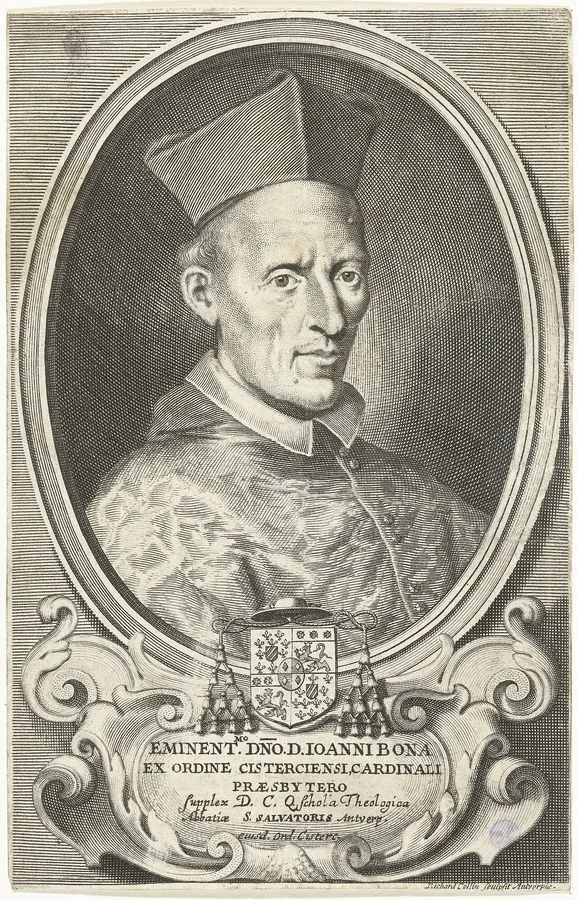
Author
Giovanni Bona
1609–1674
Giovanni Bona (1609–1674) was born at Mondovì in Piedmont and in 1625 entered the Feuillants, a reformed congregation of the Cistercian order. He taught philosophy and theology in its houses, was elected abbot general of the congregation in 1651, and settled in Rome, where he served in the Roman congregations. Clement IX made him a cardinal in 1669, and he was considered a possible pope at the conclave of 1670.
He was both a historian of the liturgy and a spiritual writer. His Rerum liturgicarum libri duo, a history of the Mass drawn from ancient manuscripts and sacramentaries, was one of the founding works of the historical study of the liturgy. His devotional and ascetical works, among them De divina psalmodia, Via compendii ad Deum and Manuductio ad caelum, were translated into many languages and widely read into the nineteenth century.
The library holds De sacrificio Missae, a short treatise on how a priest should prepare for, celebrate and give thanks after Mass. It combines his liturgical learning with practical spiritual counsel and is the most accessible of his works.
Works
Texts currently available in the library.