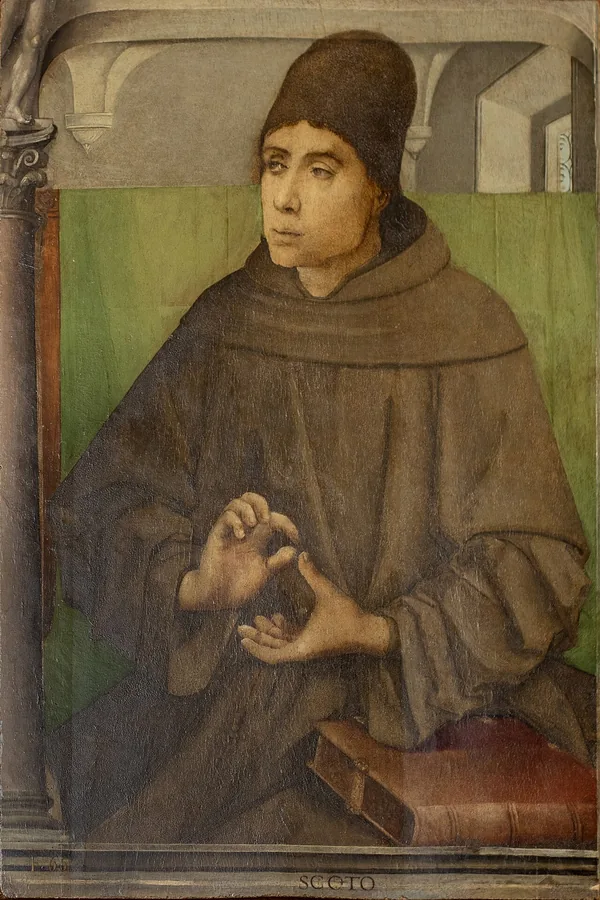
Author
John Duns Scotus
1266–1308
John Duns Scotus (c. 1266–1308) was born at Duns in the south of Scotland and entered the Franciscan order. He studied and taught at Oxford, Cambridge and Paris, where he became a master of theology in 1305, and he was sent to the Franciscan house of studies at Cologne, where he died in 1308. His cult was confirmed in 1993, when he was declared Blessed.
Called the Subtle Doctor, he examined and often rejected the positions of Thomas Aquinas and Henry of Ghent with exceptional precision. He held that being is said in one sense of God and creatures, that each individual is constituted by its own principle of individuality, that the will is free in a strong sense, and that Christ would have become incarnate even had there been no sin; he also argued for the Immaculate Conception. His followers formed the Scotist school, which with Thomism was one of the two principal schools of the later scholastic period, represented in this library by Frassen, Briceño and Dupasquier.
The library holds his Ordinatio, the revised text of his lectures on the Sentences of Peter Lombard and his principal work. The prologue and the first distinctions of the first book contain his best-known arguments.
Works
Texts currently available in the library.